
Programmatic advertising gives healthcare and pharmaceutical marketers access to premium display, online video, connected TV and audio inventory - but it does not remove the regulatory and privacy obligations attached to the message, audience and data flow.
The safest way to plan healthcare media is to decide the campaign type before choosing a DSP or audience. A hospital awareness campaign, an HCP education campaign and a consumer prescription-drug campaign may use similar media formats, but they should not share the same targeting logic, conversion signals or approval workflow.
This guide explains how to build a practical healthcare programmatic plan in 2026. It is an operational framework, not legal advice. Final campaigns should be reviewed by the advertiser’s legal, regulatory, privacy and medical teams for every market in scope.
Quick answer: Healthcare and pharma brands can use programmatic advertising when the campaign is designed around the market, product category and intended audience. Keep HCP and patient-facing strategies separate; avoid diagnosis-level or inferred-health targeting; use contextual, permitted predefined and professionally sourced audiences; minimize data collection; and measure with aggregated, consented signals. Prescription-drug promotion requires additional regulatory review, and public-facing rules differ sharply between the United States and Europe.
Why Healthcare Programmatic Advertising Needs a Different Operating Model
In an ordinary consumer campaign, a marketer may begin with an audience segment and optimize toward an online conversion. Healthcare reverses that sequence. The team must first define what can be promoted, to whom, in which market, using which data and with which evidence.
Four controls should sit above the media plan:
Promotion control: Is the product or service permitted to be advertised in the target market, and is platform certification required?
Audience control: Is the campaign intended for patients, caregivers, healthcare professionals, payers or a broad public audience?
Data control: Could the targeting, landing page or conversion event reveal or infer a health condition?
Measurement control: Can success be measured without sending protected, sensitive or directly identifiable health information to an advertising platform?
A DSP can enforce platform policy, but it cannot replace the advertiser’s regulatory review. Approval in a platform does not prove that a creative, claim, audience or data flow complies with every applicable law.
Start by Classifying the Campaign
Campaign type | Typical objective | Safer planning approach | Main risk to control |
|---|---|---|---|
Provider or hospital awareness | Promote locations, service lines or brand awareness | Broad geo, contextual media, non-sensitive predefined audiences and aggregated reporting | Tracking on appointment, portal or condition-specific pages |
OTC or consumer-health product | Awareness, education or retail demand | Confirm product and market eligibility; use compliant claims and brand-safe inventory | Inferring a condition from browsing, purchase or conversion behavior |
Prescription-drug DTC | Consumer education or branded demand | Market-by-market legal review, FDA/market-compliant creative, approved inventory and restricted targeting | Promotion rules, fair presentation of risk, platform certification and sensitive personalization |
HCP promotion | Reach verified clinicians by specialty, role or practice context | Professionally sourced HCP data, licensed publishers, PMPs and separate HCP creative | Data provenance, credential accuracy and mixing professional and patient audiences |
Disease awareness | Educate a broad audience about symptoms or screening | Contextual and broad-reach planning without diagnosis-level audience creation | Turning educational interest into a persistent health profile |
Clinical-trial recruitment | Generate qualified study enquiries | Ethics/legal review, careful geo and contextual strategy, privacy-safe form and vendor design | Collection or transfer of health status, eligibility or treatment information |
US, EU and UK Rules Are Not Interchangeable
United States
The FDA’s Office of Prescription Drug Promotion reviews prescription-drug promotional communications to help ensure they are truthful, balanced and accurately communicated. Consumer-facing prescription promotion therefore needs an approval workflow that covers the claim, indication, risk presentation, landing page and each material variation - not only the master video.
HIPAA applies to covered entities and business associates when protected health information is involved. HHS guidance also makes clear that tracking technologies can create HIPAA obligations when they receive PHI from regulated entities. The current guidance contains an important court-related limitation concerning certain unauthenticated public webpages, but that does not make all healthcare tracking safe. Authenticated portals, appointment flows and other PHI-bearing experiences need especially strict controls.
Healthcare marketers must also consider rules outside HIPAA. Washington’s My Health My Data Act, for example, protects certain consumer health data beyond HIPAA and includes inferred health data in its scope. Similar state requirements mean “not covered by HIPAA” should never be treated as equivalent to “unrestricted advertising data.”
European Union and United Kingdom
Health data is special-category data under GDPR/UK GDPR. Processing generally requires both a lawful basis and a valid special-category condition, with additional transparency, minimization and security expectations. Consent requirements for cookies and similar technologies may also apply.
Public advertising of prescription-only medicines is prohibited in the EU and UK. HCP promotion is governed separately and must follow the relevant market rules. The UK MHRA’s Blue Guide provides the operating reference for advertising and promoting medicines in the UK. Do not copy a US consumer prescription campaign into Europe by translating the creative.
Planning rule: Build one matrix by market × product category × audience type before trafficking. If a cell is not explicitly approved, do not assume that a neighboring market’s approval applies.
What Targeting Can Healthcare Advertisers Use?
1. Contextual targeting
Contextual targeting selects the environment rather than creating a profile that claims something about the individual viewer. Examples include medical-news content, professional journals, healthy-living programming, relevant publisher sections or educational video topics.
Context still requires judgment. A page about a rare condition can be highly sensitive even without a named audience. Review the content taxonomy, excluded topics, URLs and publisher list rather than accepting a broad “health” category without inspection.
2. Broad geography and service-area planning
Healthcare providers can align media to genuine service areas, markets or approved locations. Avoid combining narrow geography with other attributes in a way that makes individuals or small patient groups identifiable. For sensitive campaigns, broader regions and sensible minimum audience thresholds are safer than hyper-local microsegments.
3. Platform-defined audiences permitted for sensitive categories
Google restricts advertiser-curated audiences for sensitive-interest categories, while permitting certain predefined audiences that are configured to exclude sensitive signals. Policy eligibility is determined by the promoted content and campaign setup, so the team should review the platform’s current rule before launch rather than relying on an old audience template.
4. Verified HCP audiences
HCP campaigns may use professional attributes such as specialty, practice type or licensed-role data when sourced and activated under appropriate contracts and market rules. Document the vendor, source, permitted purpose, refresh cadence, match method and minimum audience size.
HCP targeting should identify a professional role - not reveal the clinician’s own health status or create a proxy for a patient population.
5. Consented first-party data - with strict separation
First-party data is not automatically safe because the advertiser collected it directly. A newsletter subscriber, portal user, appointment requester and patient are not interchangeable advertising audiences. Data collected for care, treatment, payment or another health-related purpose should not be repurposed for ad targeting without a validated legal and policy basis.
Where first-party activation is permitted, use a documented consent state, purpose limitation, suppression rules, minimum audience thresholds and approved technical path. Never pass diagnoses, prescriptions, appointment details, medical-record identifiers or sensitive form fields into DSP tags, URL parameters or offline-conversion uploads.
Targeting Approaches to Avoid
Building audiences that assert or infer a person has a named condition.
Retargeting people because they visited a diagnosis, treatment, appointment or patient-portal page.
Uploading patient, prescription, claims or appointment data to an advertising platform.
Using exact-location or very small geographic combinations around sensitive facilities.
Combining multiple filters until a patient or small group becomes practically identifiable.
Sending sensitive form values, page names or query strings into analytics or media tags.
Allowing audience expansion or automated optimization to move beyond the approved audience logic without review.
Choosing a DSP and Inventory Strategy
The “best healthcare DSP” is not simply the platform with the most audience segments. Selection should start with policy support, data controls, inventory quality and auditability.
Requirement | What to verify | Why it matters |
|---|---|---|
Healthcare eligibility | Product, advertiser and market certification; restricted-content policy; review SLA | A technically available format may still be ineligible for the campaign |
Audience governance | Allowed audience types, expansion controls, geography limits and minimum sizes | Prevents sensitive or overly narrow personalization |
Premium inventory | Publisher allowlists, PMPs, CTV supply paths, app/site transparency and ads.txt/app-ads.txt | Supports brand safety and reduces opaque supply |
Data minimization | Tag parameters, log fields, match process, retention, deletion and vendor contracts | Reduces unnecessary sensitive-data exposure |
Creative control | Versioning, market approval, risk-copy legibility, audio and video QA | Protects the approved claim/risk balance across formats |
Measurement | Aggregated reporting, conversion design, clean-room options and access controls | Allows optimization without patient-level reporting |
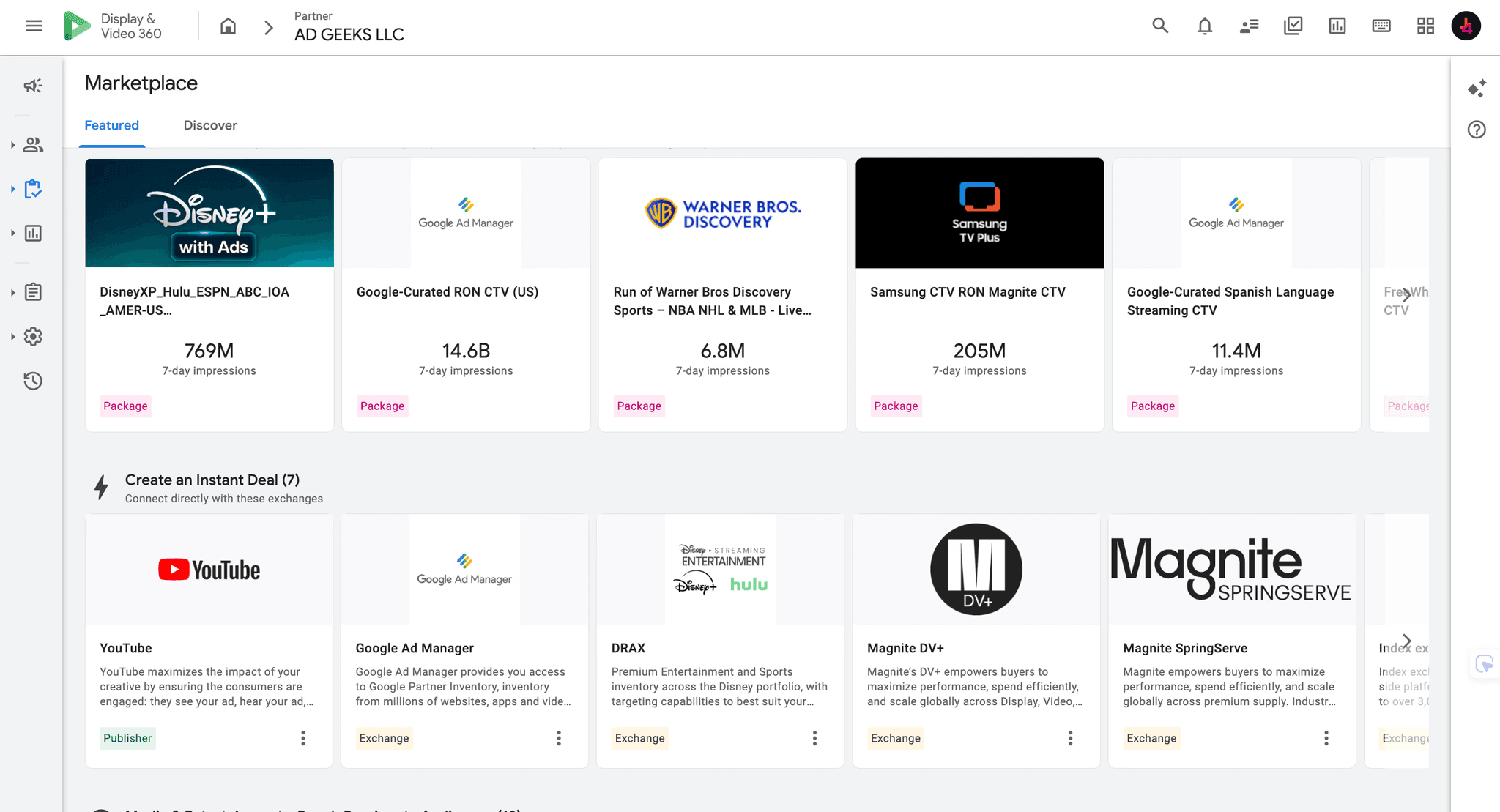
Display & Video 360 can support display, video, audio and CTV planning, but healthcare eligibility, certification and audience restrictions still depend on the product and market. For CTV strategy, see the AdGeeks Connected TV solution. A multi-channel plan should use the same approved audience and measurement boundaries across every buying platform.
Creative and Landing-Page Compliance
Build a claims matrix before producing assets
Create a controlled source of truth for approved claims, indication, substantiation, safety language, required disclosures, market, audience and expiry date. Every banner, video cut, audio spot and landing page should map back to that record.
Review the complete experience
Regulatory and platform review should cover the ad, companion unit, click URL, redirect chain, landing page, form, analytics tags and post-conversion experience. A compliant banner can still lead to a non-compliant or data-leaking destination.
Design disclosures for the actual format
Do not shrink approved risk or qualification language until it becomes technically present but practically unreadable. Test real device sizes, video safe areas, audio pacing, CTV viewing distance and subtitle behavior. The approved master file is not enough if derivatives change legibility or presentation.
Separate HCP and consumer assets
Use different creative libraries, landing pages, audience permissions and trafficking labels. An HCP claim or destination should not be delivered to a consumer audience because two line items share a naming convention or asset folder.
Privacy-Safe Measurement for Healthcare Campaigns
The measurement plan should answer business questions without recreating patient-level journeys inside the ad stack.
Funnel stage | Useful metrics | Privacy-safe implementation |
|---|---|---|
Delivery | Impressions, reach, frequency, spend, viewability and completion rate | DSP and publisher reporting at aggregated level |
Attention | Qualified visits, engaged sessions and content depth | Consent-aware analytics with sensitive URLs/parameters excluded |
Professional engagement | HCP content visits, registrations or approved resource use | Separate HCP experience and validated professional-data workflow |
Provider demand | Location-page use, call clicks or appointment-flow starts | Measure the action without exporting reason-for-visit or patient details |
Incrementality | Lift, market-level outcomes or matched aggregate trends | Geo experiments, publisher studies, clean rooms or privacy-reviewed partners |
For lead or appointment flows, use an approved event taxonomy such as appointment_flow_start or provider_location_view only after privacy review. Do not encode the condition, drug, clinician, patient identity or free-text form response in the event name or parameters.
A Practical Campaign Architecture
Layer 1: Broad awareness
Use premium contextual display, online video and CTV to build reach in approved markets. Apply publisher allowlists, frequency controls and market-approved creative.
Layer 2: Relevant context
Prioritize approved content categories, professional publishers or healthcare environments without asserting that the viewer has a condition. Maintain URL and topic exclusions.
Layer 3: HCP activation
Run separate line items for verified healthcare professionals, with professional messaging, compliant destinations and controlled vendor data.
Layer 4: Permitted re-engagement
Use only if the campaign, market, page type, consent state and platform policy explicitly permit it. Exclude sensitive pages and authenticated healthcare experiences by default.
Layer 5: Aggregate optimization
Optimize toward approved engagement and business outcomes at a level that does not expose sensitive individual behavior. Review automated audience expansion, bidding signals and model inputs before activation.
Healthcare Programmatic Launch Checklist
Define the market, product category and audience. Separate patient/DTC, HCP, provider and disease-awareness strategies.
Document the legal and platform route. Record required certifications, prohibited markets, approved claims and responsible reviewers.
Map every data flow. Include pixels, analytics, consent signals, form fields, URLs, audience vendors, DSPs and reporting exports.
Approve targeting in writing. List permitted audience types, contextual categories, geography, exclusions, minimum sizes and expansion settings.
Build a market-specific creative library. Link each asset to its approved claim, audience and expiry date.
Preflight the destination. Check redirects, privacy disclosures, consent behavior, tags, forms and authenticated areas.
Validate supply. Use approved publishers, transparent supply paths, brand-safety controls and exclusion lists.
Test measurement. Confirm that no protected, sensitive or directly identifiable health data reaches advertising platforms.
Launch with conservative automation. Review audience expansion, optimized targeting and algorithmic goals before enabling them.
Keep an audit trail. Store approvals, asset versions, settings, vendors, data maps and change history.
AdGeeks can turn your market, product and audience brief into an activation-ready media plan: approved channel mix, DSP route, targeting guardrails, inventory controls, creative requirements, data-flow checklist and measurement framework.
The preflight supports media and technical planning; it does not replace legal, medical or regulatory advice.
Frequently Asked Questions
Can pharmaceutical companies use programmatic advertising?
Yes, when the product, market, creative, audience and data use are permitted. Prescription-drug promotion requires additional regulatory controls, and public-facing eligibility differs substantially between the US and Europe.
Can healthcare advertisers retarget website visitors?
Not by default. Retargeting can be prohibited by platform policy or create privacy risk when a page visit reveals or implies a health condition, treatment, appointment or patient relationship. Sensitive and authenticated pages should be excluded, and any permitted use requires legal, privacy and platform review.
Is contextual targeting safer for healthcare campaigns?
It is often a safer starting point because it targets content rather than asserting a sensitive trait about a person. However, highly specific health content can still be sensitive, so contextual categories, URLs and publishers require review.
Can a DSP receive patient or prescription data for optimization?
Healthcare advertisers should not send patient, diagnosis, prescription, appointment or other protected/sensitive health data to a DSP unless a validated legal, contractual and platform-approved route explicitly supports the use. Standard advertising tags and conversion uploads should be designed to exclude this data.
How should HCP targeting be handled?
Use professionally sourced and contractually permitted data, document provenance, keep HCP campaigns separate from consumer campaigns, apply minimum audience thresholds and send users to an HCP-appropriate destination.
What should healthcare brands measure?
Start with aggregated delivery, reach, frequency, viewability, completion and approved engagement signals. Use geo experiments, publisher studies or privacy-reviewed clean-room approaches for deeper outcomes instead of exporting patient-level journeys into the media stack.
Official Sources and Further Reading
HHS - Use of Online Tracking Technologies by HIPAA Covered Entities and Business Associates
Google Ads - Restricted Targeting in Personalized Advertising
Washington Attorney General - My Health My Data Act Guidance
Source check: reviewed September 25, 2026. Platform policies and market rules change; verify them again before launch.